

News

Miro: A New Standard in Responsible Innovation

Miro: A New Standard in Responsible Innovation The Miro monitor arm is setting new benchmarks in sustainability. It offers a high-performance solution without compromising on environmental responsibility. Designed with careful material selection, local sourcing, and longevity in mind, Miro’s responsible approach to design and unique manoeuvrability set it apart from the competition. Sustainable Choices Miro is crafted from energy-efficient materials with a lower carbon impact....

Read more
HSE Advisor

Role Purpose Support in the development, implementation and maintenance of the company’s Health, Safety & Environmental policies, processes, operational procedures, and standards.  Ensuring best practice and championing a continually improving HSE culture within the business. Key Responsibilities Liaise with and provide support to all areas of the business to eliminate, mitigate or reduce identified HSE exposures. Partner with the production management team and team leaders,...

Read more
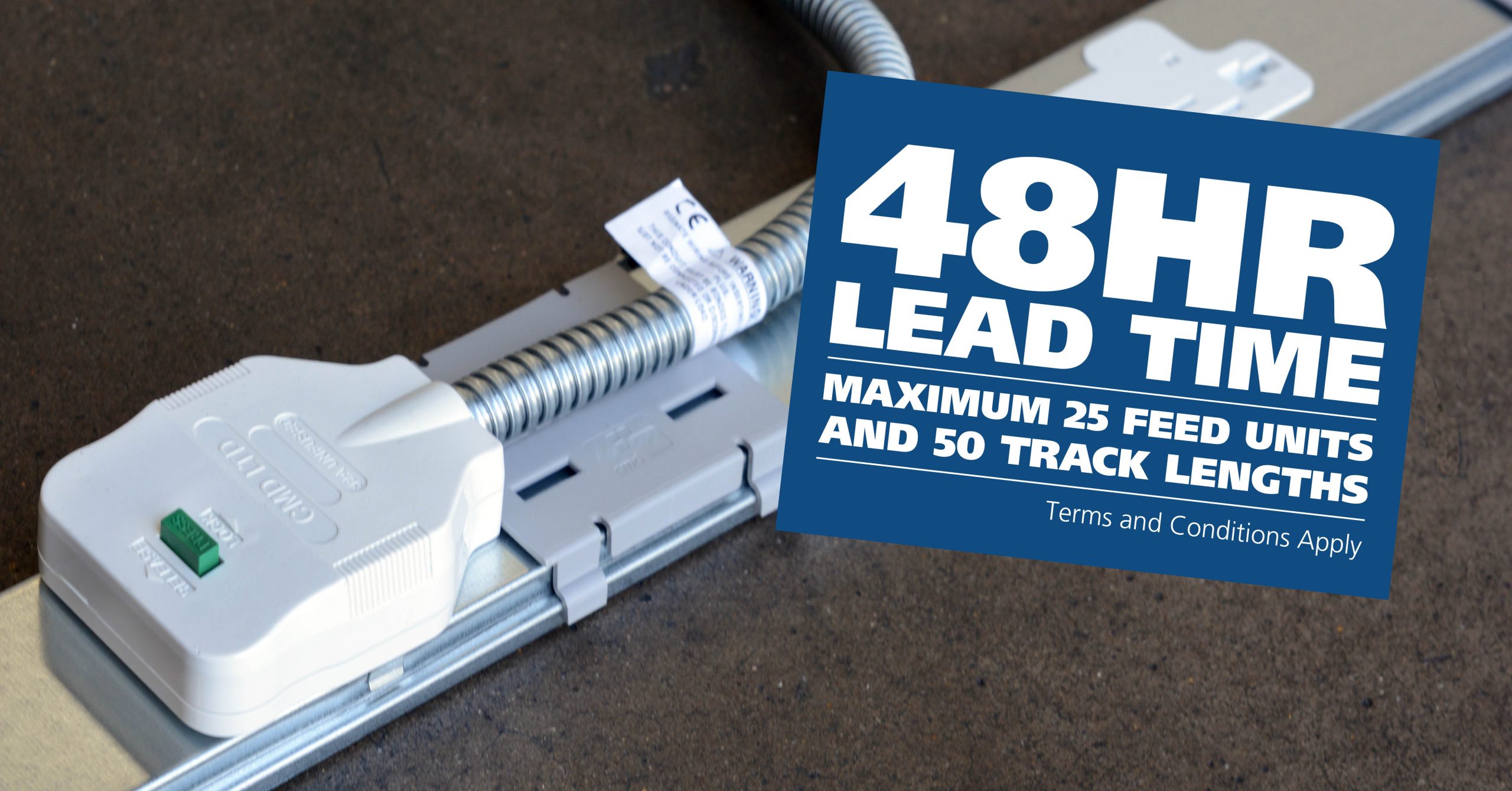
CMD Ltd LAUNCHES 48-HOUR TURNAROUND ON BETATRAK® RAPID ORDERING SERVICE

CMD Ltd, the specialist in power distribution systems, workstation power and monitor arms, has launched a rapid ordering service for its Betatrak® underfloor powertrack distribution systems and accessories, with a commitment to delivering within 48-hours of an approved purchase order*. The service enables customers to order up to 50 lengths of Standard or Clean Earth (C/E) low noise Betatrak, along with up to 25 feed...

Read more
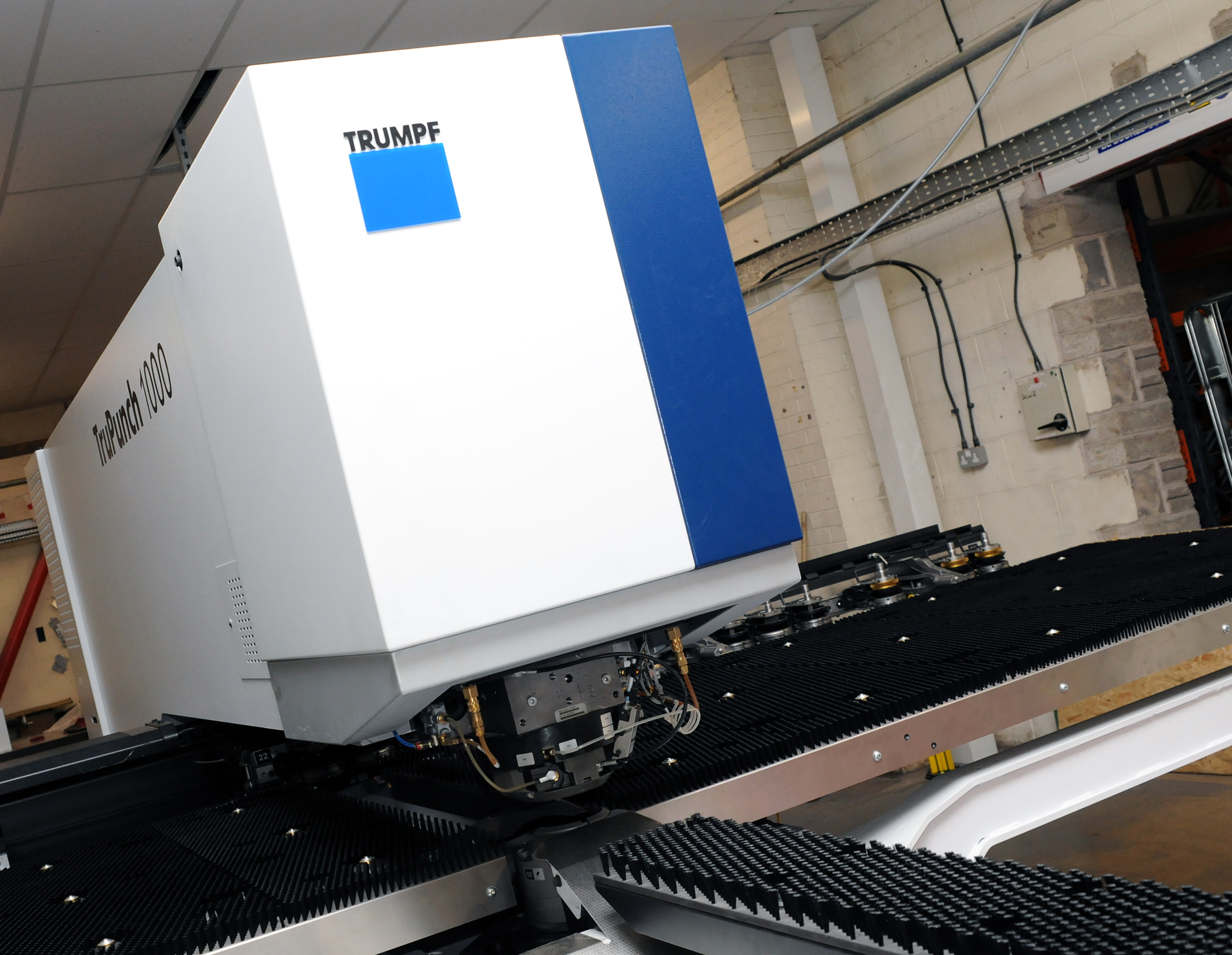
CMD INVESTS £1/4 MILLION IN NEW MACHINE AS PART OF FACTORY UPGRADE

We have invested in a new £1/4m TRUMPF CNC metal punch as part of an asset renewal strategy for our UK manufacturing capability. The new machine will be used in the production of a wide variety of our power distribution systems and workstation power products at our Rotherham factory. Suitable for handling sheet metal between 0.9mm and 3.0mm thick, the new machine will replace one...

Read more
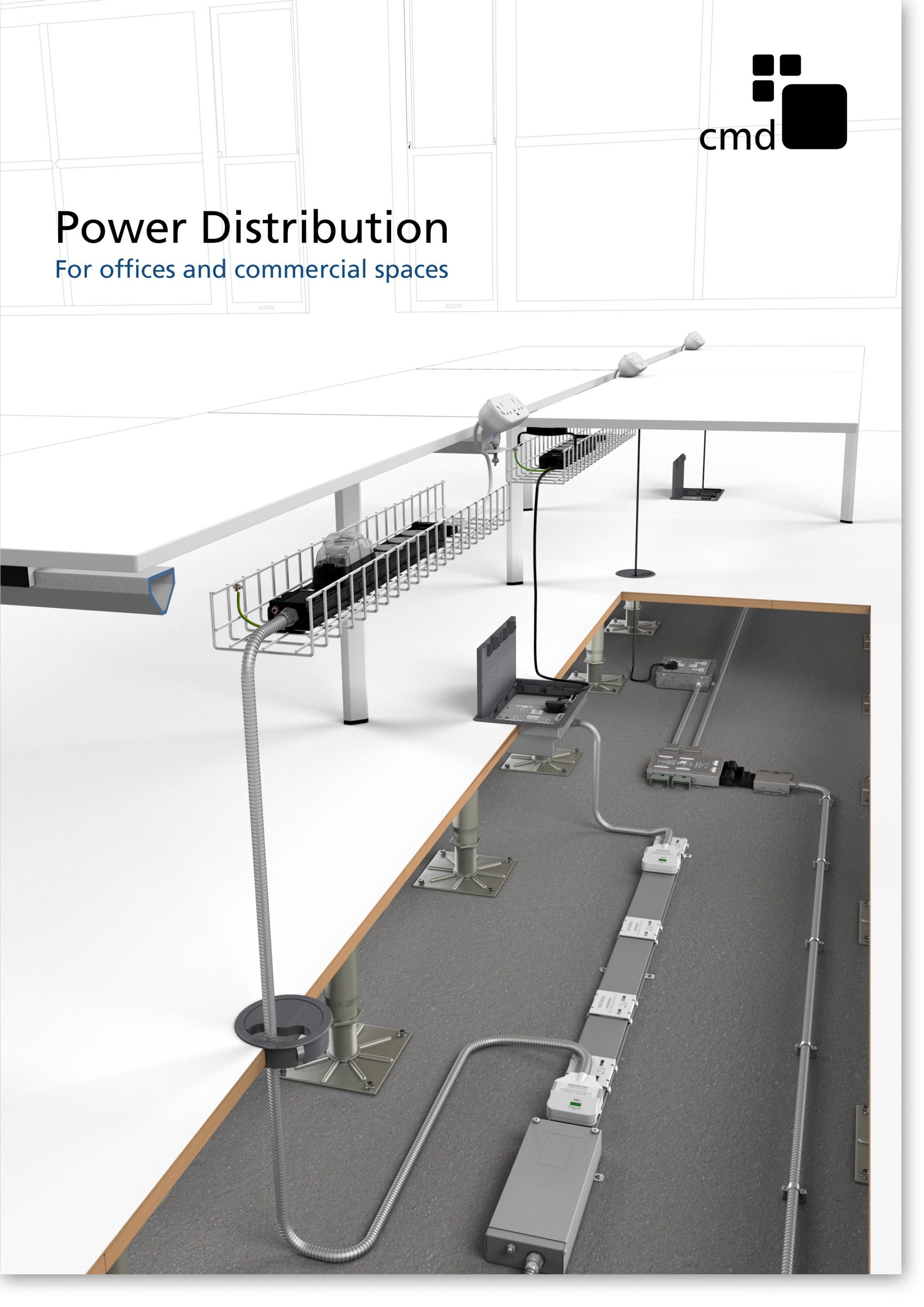
CMD CATALOGUE PROVIDES TECHNICAL POWER DISTRIBUTION GUIDE

CMD Ltd has released a new catalogue, providing an easy to follow technical guide to our power distribution systems and plug and play desk modules. Detailing CMD’s full range of UK-manufactured power distribution systems and plug and play desk modules, the catalogue will be a helpful source of information to M&E engineers and contractors alike to understand how our power distribution systems connect together and...

Read more
Power Distribution Catalogue
CMD Ltd PLAYS ESSENTIAL ROLE IN ELECTRICAL FIT OUT AT LONDON’S PRESTIGIOUS OFFICE DEVELOPMENT

CMD Ltd, specialist in workplace connectivity and ergonomic solutions, has provided a flexible and high-quality power distribution network for The Ray, a prestigious office development in London’s Farringdon. Well-known for being the former site of The Guardian newspaper, The Ray now stands as an 83,000ft² office development characterised by a modernised warehouse aesthetic, with level two now occupied by a global social media company. The...

Read more

The Ray
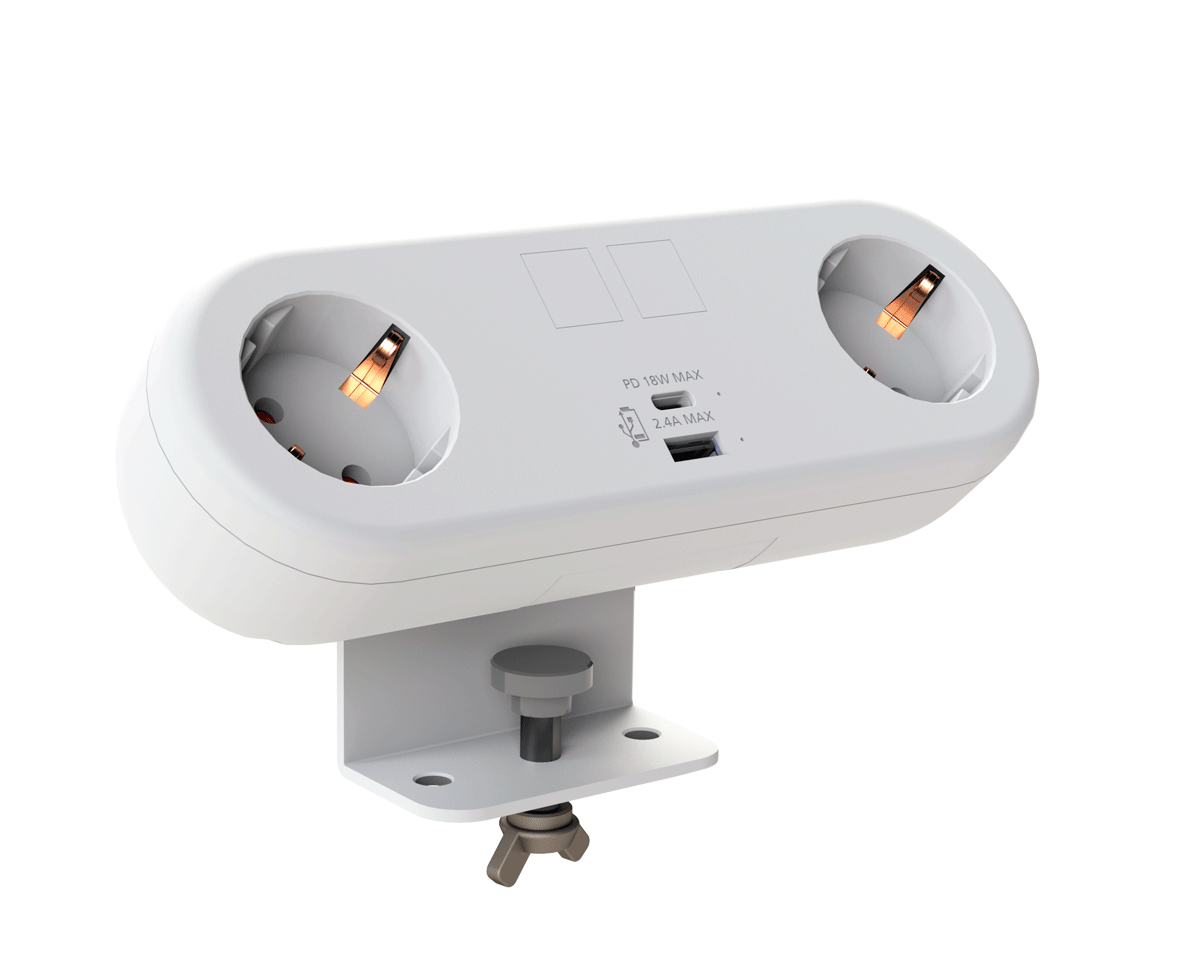
CMD plugs in to european opportunity with Schuko Capsule unit launch

CMD Ltd, the specialist in power and connectivity solutions for commercial environments, has launched a Schuko version of its popular fixed format Capsule workstation power module for export to mainland Europe and beyond. A popular on desk power module comprising two sockets and dual USB (type A and C) chargers, CMD’s Capsule unit is already widely specified in the UK as an off-the-shelf workstation power...

Read more
CMD White Schuko Capsule Desk Power Module
CMD LTD EXTENDS MONITOR ARM RANGE WITH THE LAUNCH OF REACH PLUS

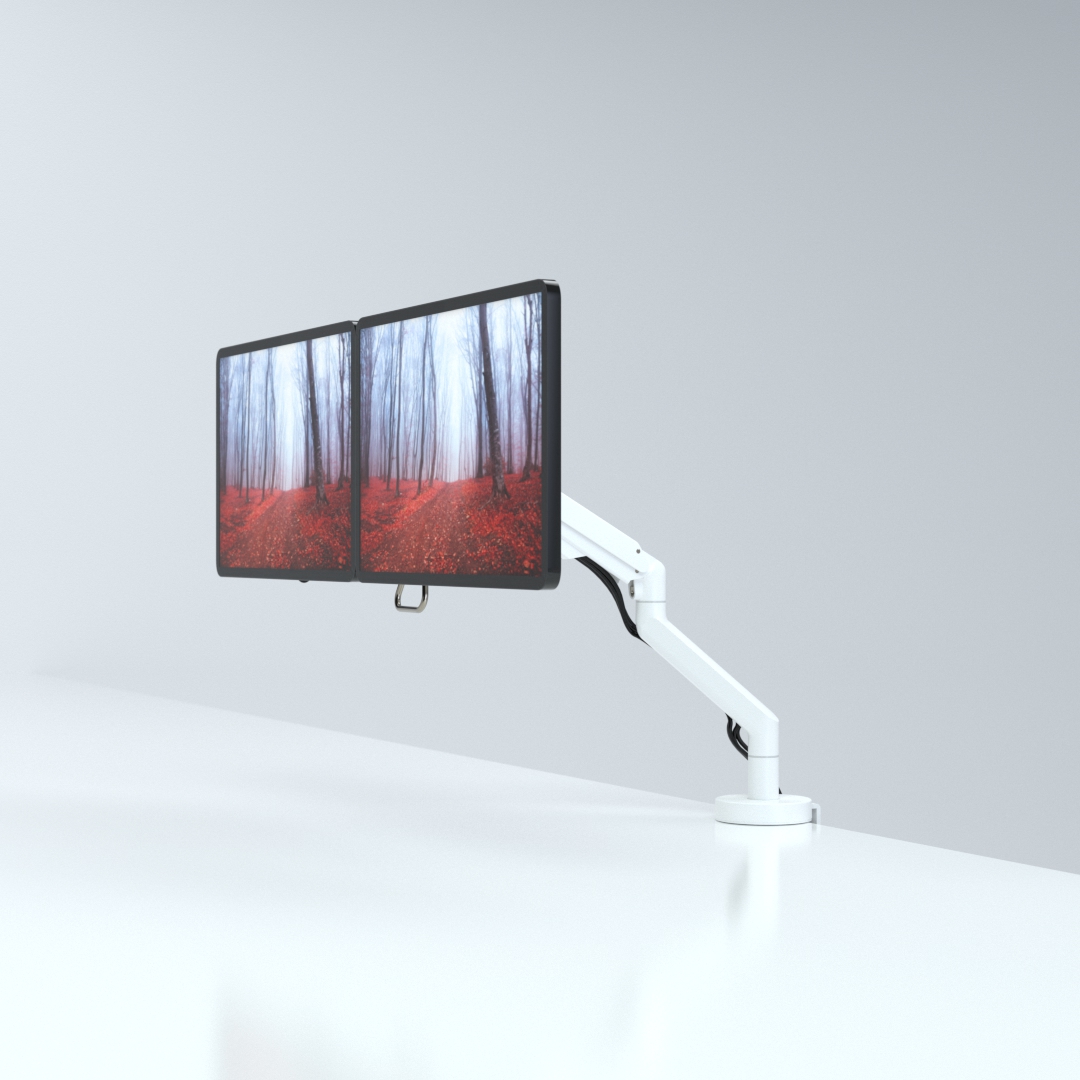
CMD Ltd, the specialist in ergonomic and connectivity solutions for commercial interiors, has completed its Reach monitor arm range with the launch of the Reach Plus. Available in single or dual screen options, the Reach Plus has been designed to provide an ideal solution for both single and dual screen workstation configurations, or can be used with next generation of large format curved screens. Suitable...

Read more
CMD Ltd DEMONSTRATES THE ART OF POWER DISTRIBUTION AT THE UNIVERSITY OF WARWICK

CMD Ltd, the specialist in workplace connectivity and ergonomic solutions, has provided Betatrak busbar power distribution and a range of electrical accessories for two major capital investment projects at the University of Warwick. Designed by Fielden Clegg Bradley Studios, the £33 million Faculty of Arts building is a showpiece development comprising four interconnected structures set around a central atrium, which will enable inter-disciplinary collaboration across...

Read more

University of Warwick
CMD BRINGS HARMONY TO COVENTRY UNIVERSITY RESEARCH FACILITIES

CMD Ltd, the specialist in power distribution solutions and workstation power and ergonomics, has provided under desk and on desk power modules for the refurbishment of three Coventry University research buildings. Located on Coventry University Technology Park, a business park designed to encourage collaboration between the university and knowledge-based businesses, the three buildings are being repurposed as office accommodation for university research teams. The refurbishment...

Read more

Coventry University

Top 10 Types of Exhaust Fans for Global Buyers

Choosing the right exhaust system begins with evidence, not attractive packaging. This guide, “Top 10 Types of Exhaust Fans for Global Buyers,” examines airflow, noise, energy use, installation conditions, and maintenance demands. These details matter in kitchens, bathrooms, factories, warehouses, and commercial buildings.

The U.S. Environmental Protection Agency reports that indoor pollutant levels can be two to five times higher than outdoor levels, and sometimes much higher. That finding gives exhaust ventilation a practical purpose: removing moisture, odors, heat, and airborne contaminants at their source. ASHRAE Standard 62.1 and Standard 62.2 provide widely recognized ventilation guidance for commercial and residential spaces. However, a fan’s rated airflow is not its real performance. Duct length, bends, filters, louvers, and pressure resistance can reduce delivery. A 1,000-cubic-foot-per-minute fan may deliver far less after installation. That is easy to overlook.

Joseph G. Allen, an indoor-air-quality researcher at Harvard T.H. Chan School of Public Health, has said, “Ventilation is one of the most important tools we have to improve indoor air quality.” His statement supports a careful buying process, especially for global projects with different climates and electrical standards. The following overview compares axial, centrifugal, mixed-flow, roof-mounted, wall-mounted, explosion-resistant, and other major designs. It also considers practical certification and service issues. Not every popular model is suitable. Sometimes, the cheapest option becomes the loudest and most expensive choice. This guide is not perfect; performance still depends on professional sizing, local codes, and honest site measurements. For buyers evaluating Exhaust Fan Exhaust Fan solutions, those limitations deserve attention before any purchase decision.

Top 10 Types of Exhaust Fans for Global Buyers

## What Exhaust Fans Are and How They Work

What Exhaust Fans Are and How They Work

An exhaust fan removes stale, humid, or contaminated air from an enclosed space. Its motor rotates an impeller, creating a pressure difference. Air then travels through grilles, ducts, and an external outlet. Replacement air enters through doors, windows, or designed intake vents. Without makeup air, airflow can weaken and doors may become difficult to open.

Fan performance depends on more than motor wattage. Buyers should check airflow, measured in m³/h or CFM, plus static pressure, noise, efficiency, and duty cycle. A short duct needs less pressure than a long duct with several bends. The U.S. EPA reports that indoor pollutant levels can be two to five times higher than outdoor levels. The International Energy Agency’s Buildings 2023 report also states that buildings use about 30% of global final energy. Efficient ventilation matters, but energy savings can be overstated when installation losses are ignored.

Tips: Match the fan to the room volume and required air changes. Confirm duct diameter before ordering. Select corrosion-resistant materials for bathrooms, kitchens, and coastal sites. Check the ingress protection rating for wet locations. A backdraft damper helps prevent reverse airflow, though it may add resistance. Test the installed airflow, not only the catalog rating. That small distinction often exposes poor design.

Top 10 Types of Exhaust Fans for Global Buyers

What Exhaust Fans Are and How They Work

No. Exhaust Fan Type How It Works Typical Applications Typical Airflow Range Main Advantages Important Buying Considerations
1 Wall-Mounted Propeller Fan A rotating propeller moves air directly through a wall opening, usually exhausting air from one side to the other. Warehouses, workshops, garages, agricultural buildings, and large utility areas. 1,000–30,000 m³/h High airflow, simple construction, easy installation, and relatively low purchase cost. Best for short air paths and low-resistance systems; not ideal for long ducts or high static pressure.
2 Axial Duct Fan Axial blades move air parallel to the fan shaft through a connected duct system. Commercial ventilation, factories, tunnels, greenhouses, and general supply or exhaust systems. 500–25,000 m³/h Compact design, strong air volume, and suitability for straight duct runs. Check pressure performance carefully because airflow can decrease significantly in restrictive ductwork.
3 Centrifugal Exhaust Fan An impeller draws air into the center and turns it outward, creating higher pressure for ducted exhaust. Industrial plants, commercial kitchens, laboratories, workshops, and buildings with long duct systems. 500–20,000 m³/h Handles higher resistance, filters, bends, and longer ducts better than many axial designs. Usually larger, noisier, and more energy-intensive than simple propeller fans at comparable airflow.
4 Mixed-Flow Inline Fan A mixed-flow impeller combines axial and centrifugal airflow characteristics to provide moderate pressure and high volume. Residential, retail, office, restaurant, and light-commercial duct ventilation. 200–5,000 m³/h Good balance of compactness, airflow, pressure capability, and relatively low noise. Confirm duct diameter, operating pressure, access for maintenance, and controller compatibility.
5 Roof-Mounted Exhaust Fan The fan is installed on the roof and discharges contaminated or warm air directly outdoors. Factories, warehouses, commercial buildings, kitchens, and industrial process areas. 1,000–40,000 m³/h Saves indoor floor space and can remove heat, moisture, smoke, and airborne pollutants efficiently. Roof structure, weather protection, waterproof flashing, vibration control, and safe maintenance access are essential.
6 Bathroom and Toilet Exhaust Fan A small motor-driven impeller extracts humid or odorous air through a wall, ceiling, or short duct. Bathrooms, toilets, laundry rooms, small utility rooms, and residential wash areas. 50–350 m³/h Compact, easy to operate, and effective for controlling everyday moisture and odors. Look for backdraft protection, suitable noise rating, humidity control options, and the correct room ventilation rate.
7 Kitchen Range Hood Exhaust Fan The fan captures cooking vapors near the source and exhausts grease-laden air through a filter and duct. Residential kitchens, food-service areas, restaurants, and light commercial cooking spaces. 300–2,000 m³/h Removes smoke, steam, odors, and airborne grease when correctly sized and installed. Verify grease filtration, fire-safety requirements, duct material, make-up air, and local commercial-kitchen codes.
8 Smoke Exhaust Fan A high-temperature-rated fan removes smoke and hot gases during a fire or other emergency condition. Car parks, stairwells, atriums, tunnels, industrial buildings, and smoke-control systems. 3,000–60,000 m³/h Supports smoke management and helps maintain tenable evacuation or firefighting conditions when part of a compliant system. Temperature-time rating, emergency power, fire controls, testing, certification, and local building regulations are critical.
9 Explosion-Protected Exhaust Fan The fan is designed to reduce ignition risks in areas where flammable gases, vapors, or dust may be present. Chemical facilities, paint rooms, fuel-handling areas, battery rooms, and selected process zones. 500–15,000 m³/h Can be specified for hazardous environments with suitable electrical and mechanical protection. Hazardous-area classification, temperature class, gas or dust group, grounding, materials, and certification must match the site.
10 Heat-Recovery Exhaust Unit It exhausts stale indoor air while transferring part of its heat or cooling energy to incoming fresh air through a heat exchanger. Energy-efficient homes, offices, schools, healthcare facilities, and tightly sealed commercial buildings. 100–5,000 m³/h Improves indoor air quality while reducing ventilation-related heating or cooling losses. Consider heat-recovery efficiency, frost protection, filter maintenance, condensate drainage, pressure balance, and climate.

Selection note: Actual airflow depends on fan speed, system resistance, duct length, filters, grilles, temperature, and installation conditions. Buyers should compare performance at the required static pressure rather than relying only on free-air airflow figures.

## Top 10 Exhaust Fan Types for Different Applications

Top 10 Types of Exhaust Fans for Global Buyers

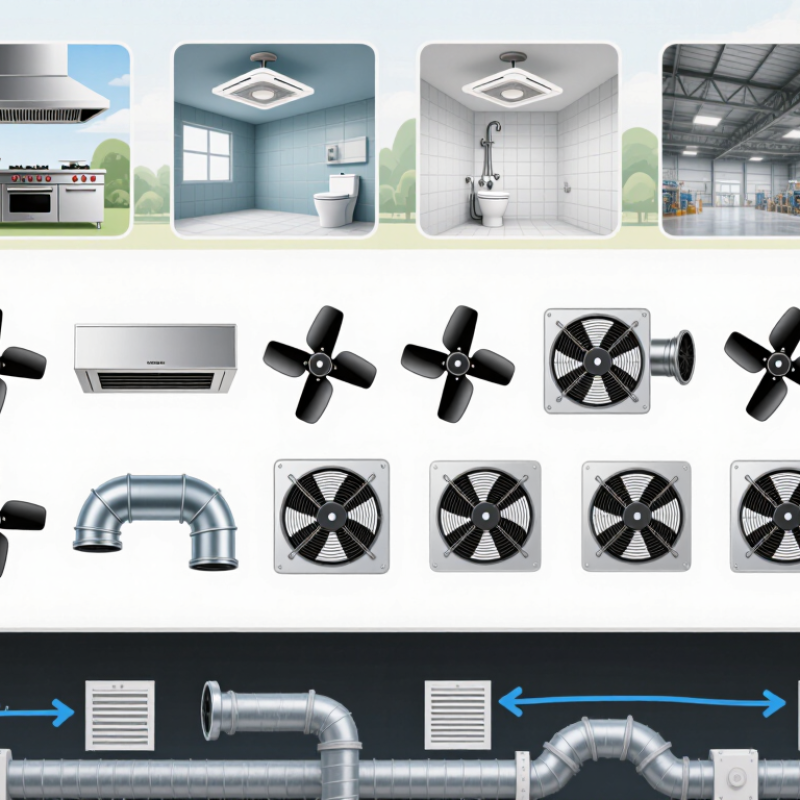
Different applications demand different exhaust fan designs. Bathroom fans remove humidity from compact rooms. Kitchen fans handle grease, heat, and cooking vapors. Wall-mounted fans suit workshops and warehouses with direct outdoor access. Window fans work well in small commercial spaces. Roof exhausters release rising heat from large buildings. Inline duct fans support long, concealed duct systems. Axial fans move high air volumes at low resistance. Centrifugal fans provide stronger pressure for complex ductwork. Mixed-flow fans balance airflow and pressure. Smoke-extraction fans serve emergency ventilation systems.

The International Energy Agency reported that buildings used about 30% of global energy in 2022. Efficient ventilation can reduce unnecessary electrical demand, but fan selection remains site-specific. The U.S. Department of Energy recommends evaluating fan efficiency, system pressure, controls, and operating schedules together. A high-airflow model may perform poorly when filters become blocked. This is often overlooked. Noise, corrosion, temperature, and cleaning access also influence service life. Buyers should request tested performance curves, sound data, material specifications, and compliance evidence based on recognized standards such as AMCA or ISO.

Tips: Measure the room volume first. Check required air changes. Confirm duct resistance before choosing motor power. For humid or corrosive areas, consider coated or stainless components. Variable-speed control can reduce airflow during low-demand periods. Still, savings depend on correct commissioning. A perfect specification can fail in a poorly balanced system.

## Key Differences in Airflow, Installation, and Noise

Top 10 Types of Exhaust Fans for Global Buyers

Choosing an exhaust fan starts with airflow, not appearance. Axial, window, wall-mounted, and portable fans move air efficiently across short distances. Inline duct, mixed-flow, centrifugal, roof, ceiling, bathroom, and kitchen fans suit different pressure demands. Centrifugal models usually handle long ducts and bends better. Axial models often provide higher volume with less resistance.

Installation conditions change the result. A ceiling fan may need a short, insulated duct run and firm mounting. Wall and window fans require accurate openings, weather protection, and secure grilles. Roof units demand safe access and careful flashing around the penetration. Inline fans save room inside, but service access must remain practical. I have seen strong fans perform poorly because installers ignored duct diameter.

Noise also depends on more than the motor rating. Air turbulence, loose panels, vibration, and sharp elbows can make a quiet fan unpleasant. Direct-drive designs may reduce maintenance, while belt-driven units can offer smoother operation in larger systems. However, belts need inspection. Keep that in mind.

A lower decibel figure may reflect laboratory testing, not a furnished room.

Global buyers should compare airflow at operating pressure, not only free-air figures. Check voltage, frequency, ingress protection, mounting dimensions, and replacement access. Local climate matters too; humid areas need corrosion-resistant materials. I still recheck every specification against the actual duct layout, because catalog assumptions rarely match the finished building.

## How to Match an Exhaust Fan to Global Buyer Requirements

Matching an exhaust fan to global buyer requirements starts with the building, not the product label. A bathroom may need a quiet ceiling fan, while a workshop requires stronger pressure handling. Measure room volume, duct length, bends, and outlet resistance before comparing airflow ratings. A high airflow figure can mislead.

Climate changes the decision. Humid coastal sites need corrosion-resistant housings and protected motors. Cold regions may require backdraft shutters and insulation to reduce heat loss. Dusty facilities benefit from accessible filters and sealed electrical parts. Check voltage, frequency, mounting space, and local certification requirements before ordering. Small mismatches create expensive delays.

Noise also matters in hotels, offices, and residential projects. Select the lowest sound level that still meets the required air exchange rate. For continuous operation, review motor efficiency, thermal protection, and service access. Keep spare parts realistic. A technically excellent fan becomes unreliable when replacement components take months to arrive.

I have seen buyers focus on airflow alone. That approach often fails. Static pressure, duct design, and installation quality can reduce real performance. Ask suppliers for tested curves, operating limits, wiring details, and maintenance guidance. Request samples or site calculations when conditions are unusual. No selection is perfect; budget, availability, and performance sometimes conflict. Recheck the assumptions before approving a large shipment.

## Safety Standards, Energy Efficiency, and Maintenance Factors

Across the ten common exhaust fan types, safety performance matters more than catalog airflow. Axial, centrifugal, mixed-flow, inline, roof, wall, jet, portable, heat-resistant, and corrosion-resistant fans serve different spaces. For global buyers, requirements vary by location. Specify a guarded impeller, secure grounding, thermal overload protection, and an accessible isolation switch. Check enclosure ratings against dust and moisture exposure. Do not treat a familiar voltage as universal. Frequency, phase, wiring methods, and emergency procedures need local verification. Products should align with applicable electrical, fire, workplace, and machinery safety requirements.

Energy efficiency depends on the whole ventilation system, not only the motor label. Select airflow after measuring room volume, heat load, contaminants, and static pressure. An oversized fan can waste electricity and create uncomfortable drafts. A low-power fan may fail under dirty filters or long ducts. Electronically commutated motors and variable-speed controls can reduce consumption during low-demand periods. However, controls need correct commissioning. Otherwise, efficiency claims remain mostly theoretical. That is an easy detail to overlook.

Maintenance should be planned before installation. Leave clear access for cleaning, belt replacement, and electrical inspection. Inspect grilles and filters regularly, especially where grease or fine dust accumulates. Listen for bearing noise and check unusual vibration early. Corrosion near coastal or chemical areas deserves faster inspection. Keep a written service log with dates, readings, and replaced parts. A perfect maintenance schedule rarely survives real operations, so review it after the first month. Small design compromises can become expensive failures.

Top 10 Types of Exhaust Fans for Global Buyers

Safety Standards, Energy Efficiency, and Maintenance Factors

The chart compares typical airflow capacity with recommended preventive-maintenance intervals for ten widely used exhaust-fan types. Airflow values represent common application ranges, while maintenance intervals assume normal commercial or light-industrial operating conditions. Buyers should verify local requirements, including IEC, EN, UL, CE, ATEX, and electrical protection standards, before selecting equipment.